


Melody Keys: Piano Beat
0.00.00 Reviews
App Specs
- Version
- 1.4
- Updated On
- License
- Free
- Downloads
- 10,000+
- Developer
- DigitalFish
- Categories
- Music
- Platform
- Android
Screenshots




 Analysis by AppCompare
I’m drawn to rhythm games that make their challenge clear right away, and Melody Keys: Piano Beat has a simple premise: watch colorful notes fall and tap them before they cross a redline. That gives each round an easy-to-understand goal, even if keeping your timing steady takes practice. As a music game from DigitalFish, it looks best suited to quick sessions when I want a focused test of attention rather than a complicated game to learn.
Finding a steady rhythm
The basic routine is straightforward: follow the notes as they descend, judge when they are approaching the line, and tap at the right moment. I’d begin by concentrating on timing rather than speed. A rushed tap can be just as disruptive as a late one, and watching the redline gives you a consistent visual reference instead of encouraging you to chase every note across the screen.
That visual focus is useful in ordinary, short breaks. I can imagine opening the game while waiting for a friend or taking a few minutes between tasks, playing a round, then putting the phone away. It does not require the sort of long-term planning that a large campaign or strategy game might demand. The trade-off is that the appeal depends on enjoying repeated, timing-based play: if you want a story, exploration, or a broader set of objectives, this is not the same kind of music game.
A practical way to approach a round
Before trying to play quickly, I’d settle into a repeatable sequence: keep my eyes slightly ahead of the notes I’m about to tap, use the redline as the timing cue, and avoid making unnecessary movements with my tapping hand. That small habit matters because frantic reactions can make it harder to judge the next note. If I miss, I’d treat the next note as a fresh timing decision rather than letting one mistake pull my attention away from the screen.
For a first session, short attempts are more useful than grinding through a long stretch while distracted. The game’s central action is easy to grasp, but visual tracking and finger timing still take attention. Playing when the phone is held steadily and the screen is easy to see gives the falling notes a fair chance to register in your attention. It is a simple adjustment, but it helps separate a timing mistake from a session spent glancing away at notifications or moving around.
I would also resist judging my skill from one unusually good or bad run. A rhythm game can feel different when I am tired, interrupted, or simply tapping too tensely. A better personal measure is whether I can keep my eyes on the incoming notes and respond consistently over several brief attempts. That turns the game into a small coordination exercise rather than a frustrating hunt for an instant high score.
What to check before settling in
Melody Keys: Piano Beat is free to start, but it includes optional in-app purchases, with individual items ranging from 49 cents to $99.99. I’d check the purchase prompts carefully before confirming anything, especially if a child will be using the device or if the phone is shared. The game is rated Everyone, but that age rating does not remove the need to review spending controls on the device itself.
Worth Reading Before You Choose

Baby Panda World Brings Quick Play to Modern Phones, but Its Game Library Feels Busy

ESPN’s Live Game View Makes Following Close Games Easier

QuizzLand Review: A Good Fit for Short Trivia Breaks, Not Every Player

Basketball Stars: Multiplayer Is Fast, but Can It Recover When Matches Go Wrong?

WEBTOON Turns Phone Updates Into a Better Reading Routine

Link to Windows Runs on Shared Habits, Not Social Feeds
The current version is 1.4, and the minimum operating-system requirement is Android 8.0. Checking compatibility before installing is a sensible first step, particularly on an older phone. For a rhythm game, stable interaction matters: if a device feels sluggish or the screen is difficult to track, that can affect the experience even when the central rules are uncomplicated. I would try a short session before deciding whether it feels comfortable on my particular device.
There is no need to assume that a music game will behave like a piano lesson. The falling-note format is about responding to visual cues, not learning notation or practising a real keyboard part. If my goal is to build music-reading skills, I’d choose a teaching app instead. If I want a quick test of timing and attention, the game’s simple premise is a more direct fit.
Building consistency without rushing
A useful habit is to treat each attempt as a small practice loop: focus on the redline, tap deliberately, and notice whether I tend to react early or late. I would change only one thing at a time. For example, if I keep rushing, I can deliberately wait until a note is nearer the line; if I’m repeatedly late, I can start preparing my finger sooner while keeping my eyes on the approaching notes. These are player strategies, not special modes or hidden tools.
That distinction is important for experienced players, too. Familiarity with rhythm games can tempt me to tap on instinct, but instinct is not automatically accurate when a particular screen layout or note flow feels different. A deliberate first run can help me read the visual rhythm before I try to play aggressively. Once I’m comfortable, I can focus on making taps smaller and more controlled, which keeps my hand from becoming a distraction.
Melody Keys: Piano Beat has over ten thousand installs, which gives a prospective player a rough sense that it has reached an audience without telling me whether it will suit my tastes. I’d decide based on the core loop instead: do I enjoy following moving notes and responding at the right moment? That is a more useful question than expecting a music game to offer every song, genre, or social feature I have seen elsewhere.
Where it fits among music games
Compared with a piano-learning app, this is a lighter, more immediate sort of activity. A learning tool is the better choice for structured lessons, technique, or understanding how notes relate to a keyboard. Compared with rhythm games built around elaborate progression or a wide range of play systems, the appeal here is the clear falling-note challenge. I would choose it for a quick timing session, not as a substitute for music instruction or a deep, long-form game.
That focus can be a strength when I have only a few minutes. There is no need to set aside a full evening to understand the basic objective: watch, time the tap, and keep going. On the other hand, someone who wants a large collection of modes or a strong sense of progression may prefer a more feature-heavy alternative. The simpler a rhythm game’s central loop is, the more its long-term appeal depends on whether repeating that loop remains satisfying for the player.
It is also worth separating music enjoyment from music control. The game asks for attention to moving visual cues, so I would not pick it when I mainly want to listen passively. Nor would I use it as a quiet background activity if I needed to concentrate on something else at the same time. Its strongest everyday use is a short, intentional break where I can give the screen my attention and enjoy trying to improve my timing.
Limits to keep in mind
The main limitation is built into the premise: tapping falling notes is a narrow kind of interaction. It can be satisfying, but it may not hold the interest of someone who needs a changing objective or a broader musical sandbox. I would also keep expectations measured about what the game teaches. Better timing in a tapping game can feel rewarding, but it is not the same as learning piano technique or gaining a wider understanding of music.
There is a practical limit, too: visual rhythm games are sensitive to how comfortably I can see and respond to the screen. If I am playing one-handed while walking, dealing with interruptions, or holding the phone at an awkward angle, I’m making the task harder for myself. I’d save it for a seated break or another moment when I can look directly at the display. That is not a complaint about the game so much as a sensible way to avoid turning a quick game into a frustrating one.
People who are sensitive to rapid visual motion may also want to try a brief session and see how it feels. The falling-note format keeps movement central to the screen, so it is not an ideal choice for everyone. Likewise, if a player expects every music game to provide a deep catalogue, social competition, or custom practice tools, they should check that the available experience suits them rather than assuming those extras are part of this one.
Who will get the most from it
I’d recommend giving it a try if you like compact rhythm challenges, enjoy improving through repetition, and want an uncomplicated objective to return to. It may also suit someone who wants to share a casual game with a friend nearby: taking turns and comparing how steady each person feels can make the basic challenge more social without needing to turn it into a serious competition.
I’d steer away from it if I were looking for a piano tutor, a detailed music-creation tool, or a game whose main draw is a long campaign. I would also skip it if repeated visual tracking is tiring or if I know that optional purchases are a poor fit for the way I manage games on my device. Those are meaningful differences in what a person wants, not shortcomings that every player needs to overlook.
Melody Keys: Piano Beat is a free music game released on May 28, 2025. Its straightforward falling-note challenge gives it a clear place among quick-play rhythm games, while optional purchases are something to consider before spending. I’d approach it with a simple routine, play in short focused bursts, and judge it by whether the timing loop itself is enjoyable. If that is what I’m after, it is an easy game to understand and a reasonable one to try.
My verdict is modest but positive: this is best treated as a small, focused test of rhythm and visual attention, not as a complete music-learning package. A steady gaze, controlled taps, and realistic expectations make for a better session than rushing after every note or expecting a broader game than the premise suggests. If that sounds like the kind of break you want, it is worth seeing whether its rhythm clicks for you.
Getting Started with Melody Keys
First off, installing Melody Keys: Piano Beat is a breeze. Available on both Android and iOS, it took me just a couple of minutes to download and get going. Once you open the app, you’re greeted with a sleek interface that’s both inviting and user-friendly. The design is clean, making it easy to navigate even for first-timers. You’ll find your way around in no time, trust me!
Gameplay that Strikes a Chord
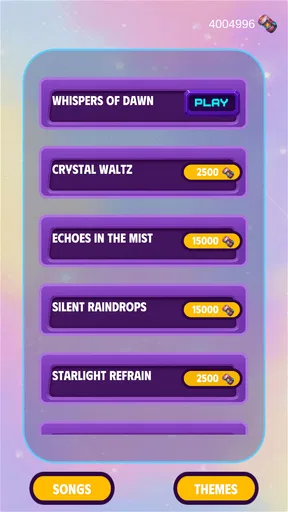
So, what’s the gameplay like? Imagine a combination of rhythm and skill as you tap away to hit notes that scroll down your screen. It’s a bit like playing a piano, but with a twist! The app offers a variety of songs from different genres, so whether you’re into pop, classical, or rock, there’s something for everyone. Personally, I found myself getting lost in the melodies, especially when I nailed those tricky sequences. It’s super satisfying!
The app does a great job of balancing difficulty. Beginners won’t feel overwhelmed, while seasoned players can crank up the challenge. And let me just say, when you hit a perfect combo, it feels like you’re on stage at a live concert. Sensational!
Features That Hit the Right Note
Now, let’s talk features. One aspect that stands out is the custom playlist option. You can curate your own list of songs to play, which is perfect if you have favorites that you want to keep coming back to. The app also updates its song library regularly, so you’re never stuck with the same tunes. I noticed new tracks being added every week, keeping things fresh and exciting.
Another cool feature is the multiplayer mode. If you’re feeling competitive, you can challenge friends or players worldwide. It adds a social element that’s both fun and engaging. I had a blast trying to outscore a buddy of mine. Spoiler: I didn’t win, but it was a close call!
Visuals and Sound: A Feast for the Senses
Visually, Melody Keys: Piano Beat doesn’t disappoint. The graphics are vibrant and dynamic, enhancing the overall experience. It’s not just about hitting the right notes; it’s about enjoying a complete sensory journey. The animations are smooth, and the colors pop, making each game session feel like a visual treat.
The sound quality is top-notch. The tracks are well-mixed, and the audio feedback is crisp, which is crucial in a rhythm game. You’ll feel every beat and note, and trust me, it makes all the difference when you’re trying to stay in sync.
Room for Improvement
No app is perfect, and Melody Keys: Piano Beat has its hiccups. Occasionally, I experienced some lag during intense sequences, which can be a bummer if you’re aiming for a high score. Also, while the song selection is vast, some niche genres are underrepresented. If you’re a fan of indie or obscure tracks, you might find yourself wanting more variety.
However, the developers seem committed to updates and improvements, so I’m hopeful these minor issues will be addressed in future versions.
Final Thoughts
All in all, Melody Keys: Piano Beat is a delightful app that brings the joy of music and gaming together in a seamless package. Whether you’re a casual player or a rhythm game aficionado, there’s plenty here to keep you entertained. With its engaging gameplay, excellent features, and stunning visuals, it’s definitely worth a try. So go ahead, download it, and let the music take you away!
Happy tapping, and may your high scores soar!
Pros
- Intuitive interface for easy navigation.
- Wide variety of songs to play.
- Responsive touch controls.
- Regular updates with new content.
- Customizable themes and layouts.
Cons
- Contains in-app purchases.
- Ads can be intrusive at times.
- Requires internet for full features.
- Limited free song selection.
- High battery usage on older devices.
FAQs for Melody Keys: Piano Beat
What is Melody Keys: Piano Beat and how does it work?
Melody Keys: Piano Beat is an interactive rhythm game that combines captivating piano melodies with engaging gameplay. Players tap on the correct keys as they appear on the screen, syncing with the music to score points. The app offers various levels of difficulty, allowing both beginners and seasoned players to enjoy and improve their skills.
Is Melody Keys: Piano Beat suitable for all age groups?
Yes, Melody Keys: Piano Beat is designed to be accessible for all age groups. Its intuitive interface and adjustable difficulty levels make it a great choice for kids, teens, and adults alike. The app also offers a family mode, ensuring a safe and enjoyable experience for younger audiences.
Does Melody Keys: Piano Beat require an internet connection?
Melody Keys: Piano Beat can be played offline, allowing users to enjoy the game anywhere without needing an internet connection. However, connecting to the internet is recommended for downloading new songs and accessing additional features such as leaderboards and social sharing.
Are there in-app purchases in Melody Keys: Piano Beat?
Yes, Melody Keys: Piano Beat offers in-app purchases. While the core gameplay is free, users can purchase additional song packs and customization options. These purchases enhance the gaming experience by providing access to more content and personalization features without being mandatory for enjoying the game.
How can I improve my skills in Melody Keys: Piano Beat?
Improving your skills in Melody Keys: Piano Beat involves practice and familiarization with the game mechanics. Starting with easier levels and gradually increasing the difficulty helps build proficiency. The app also provides tutorials and tips to help players develop better timing and accuracy, enhancing their overall performance.


